SAGE

A Hybrid Vision–Language and Geometry Framework for Work-Zone Pathway Prediction under Temporary Traffic Control

Semantic-to-Action Grounded Execution

Jiaxi Liu, Weizhe Tang, Bofeng Cao, Sikai Chen, Xiaopeng Li, Steven T. Parker, Bin Ran*

University of Wisconsin–Madison

*Corresponding author

SAGE uses a vision–language model's trajectory as an opinion over intact geometric candidates and checks the chosen path against MUTCD provisions with a bounded intervention, so geometry writes every coordinate of the output.

Highlights

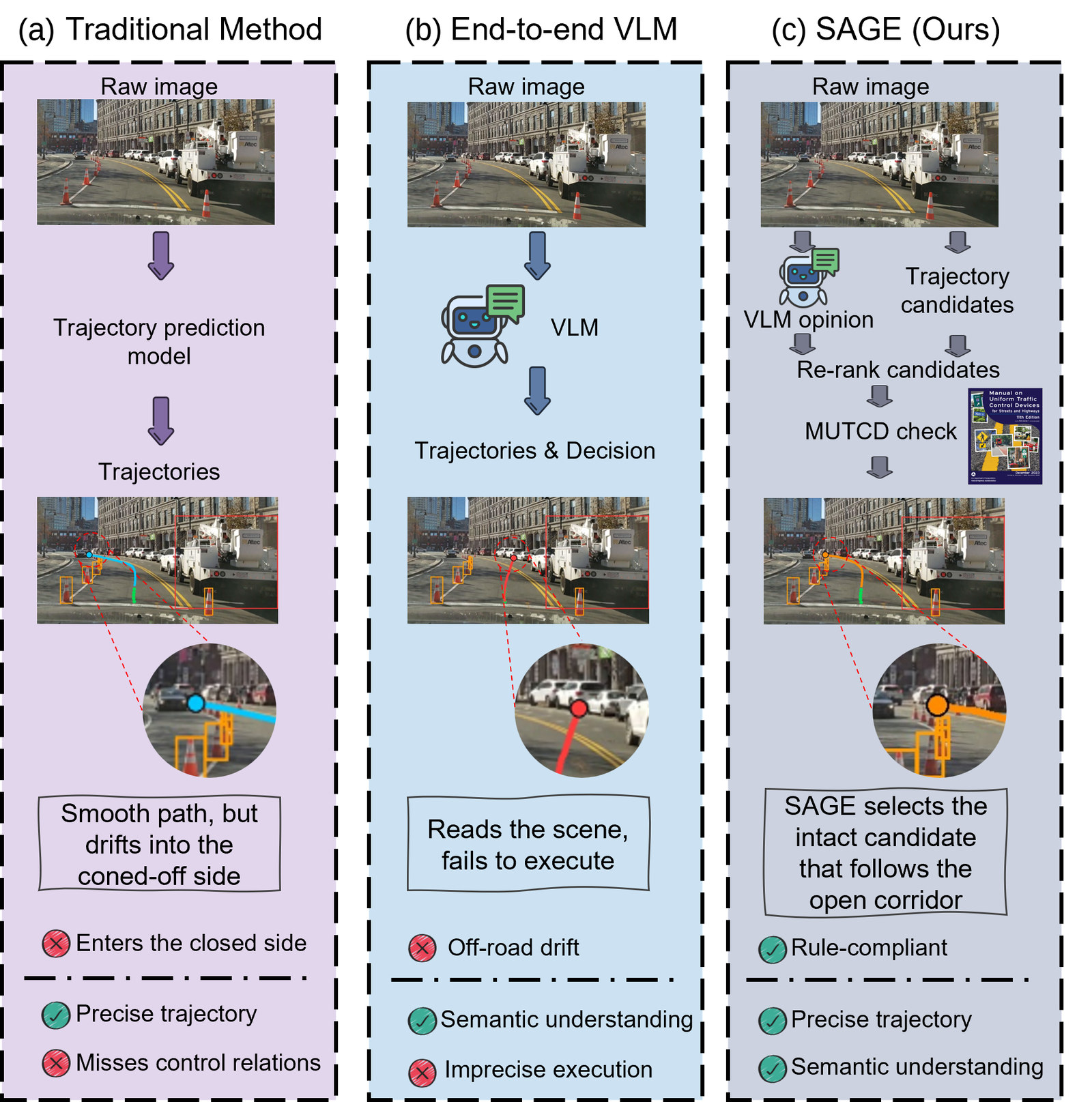
Three ways to predict a work-zone pathway: a geometric predictor drifts toward the coned-off side, an end-to-end VLM reads the scene but executes imprecisely, and SAGE re-ranks intact geometric candidates with the VLM opinion and checks them against MUTCD provisions.
Temporary-control-aware pathway prediction. (a) A geometric predictor selects a smooth path toward the coned-off side. (b) A VLM provides a scene interpretation and an imprecise trajectory. (c) SAGE uses the trajectory as a preference over intact geometric candidates and the structured reading as input to checks derived from MUTCD provisions. The paths illustrate the division of labor.
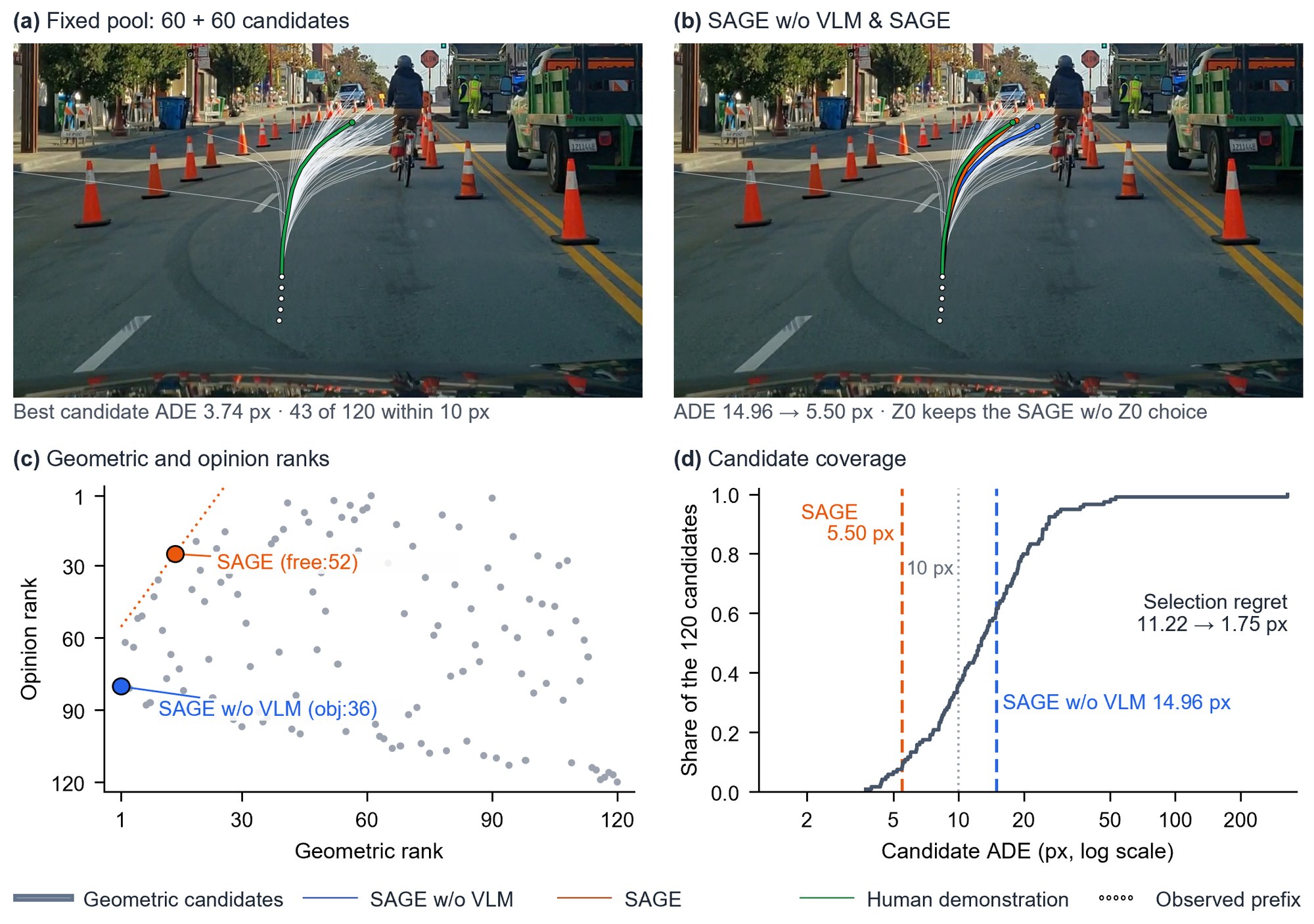
  1. Selection is the bottleneck. The 120 geometric candidates contain a path within 10 px of the human demonstration in 87% of episodes, yet selection regret accounts for 53% of the geometric ranker's error.

  2. Trajectory as opinion. SAGE-VLM's trajectory ranks the intact candidates by distance, and rank fusion with the geometric score improves all four tested generator–selector combinations.

  3. Read the zone, then check the path. MUTCD-structured supervision has SAGE-VLM state the lane status and hazard side before its decision; MUTCD-derived predicates drive a bounded intervention that cuts hard-constraint violations by 37%.

  4. Accurate with a faster VLM. SAGE lowers ADE by 8.3% and FDE by 12.0% relative to the geometric ranker, is comparable to OneVL in accuracy with a VLM that answers in 3.45 s against 4.26 s, and outperforms four other adapted driving VLMs in displacement error and safety measures.

How SAGE works

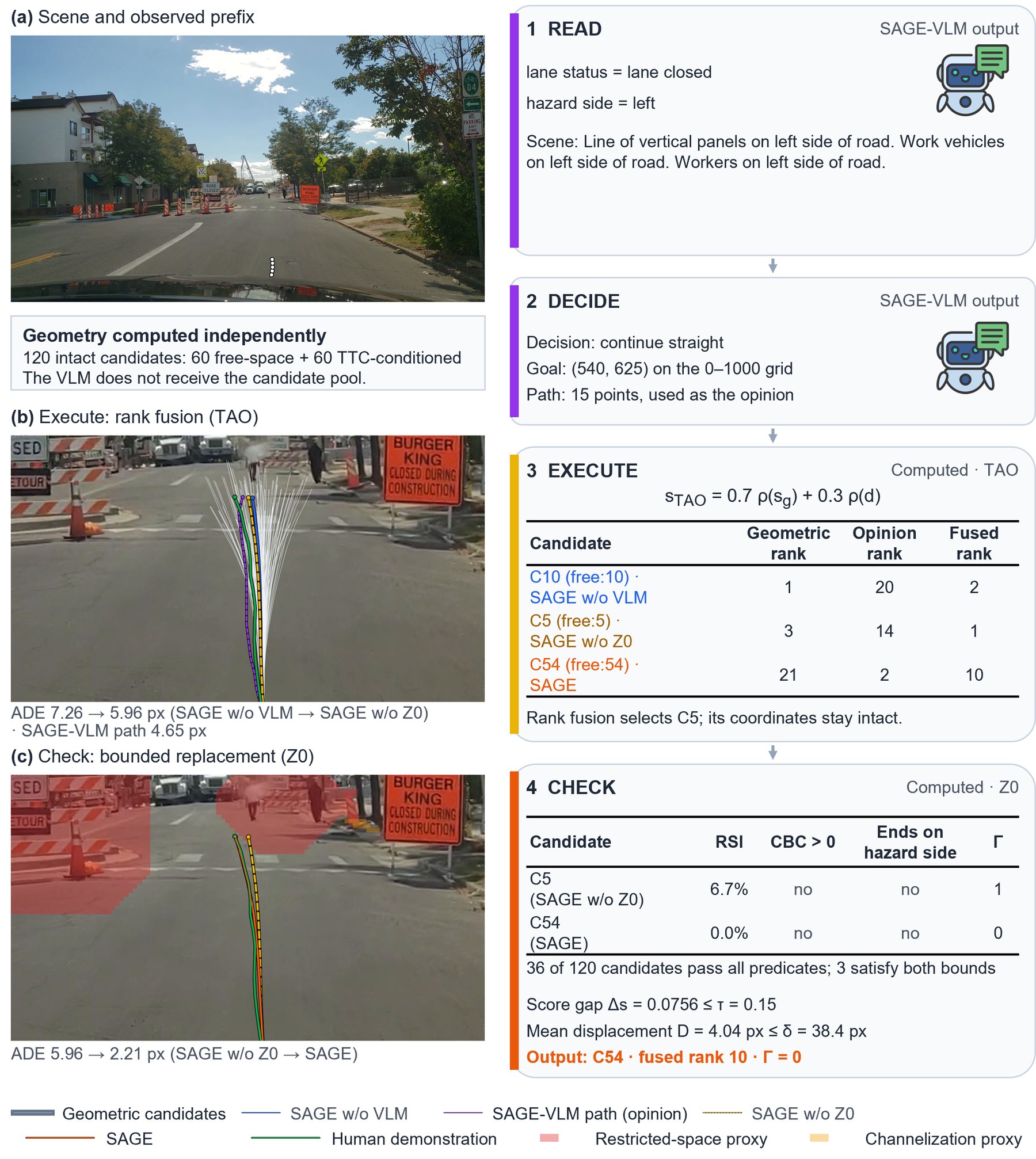
Read, decide, execute, check: four steps meet in one shared pool of candidate paths. Geometry builds every path; SAGE-VLM and the MUTCD predicates choose among them.

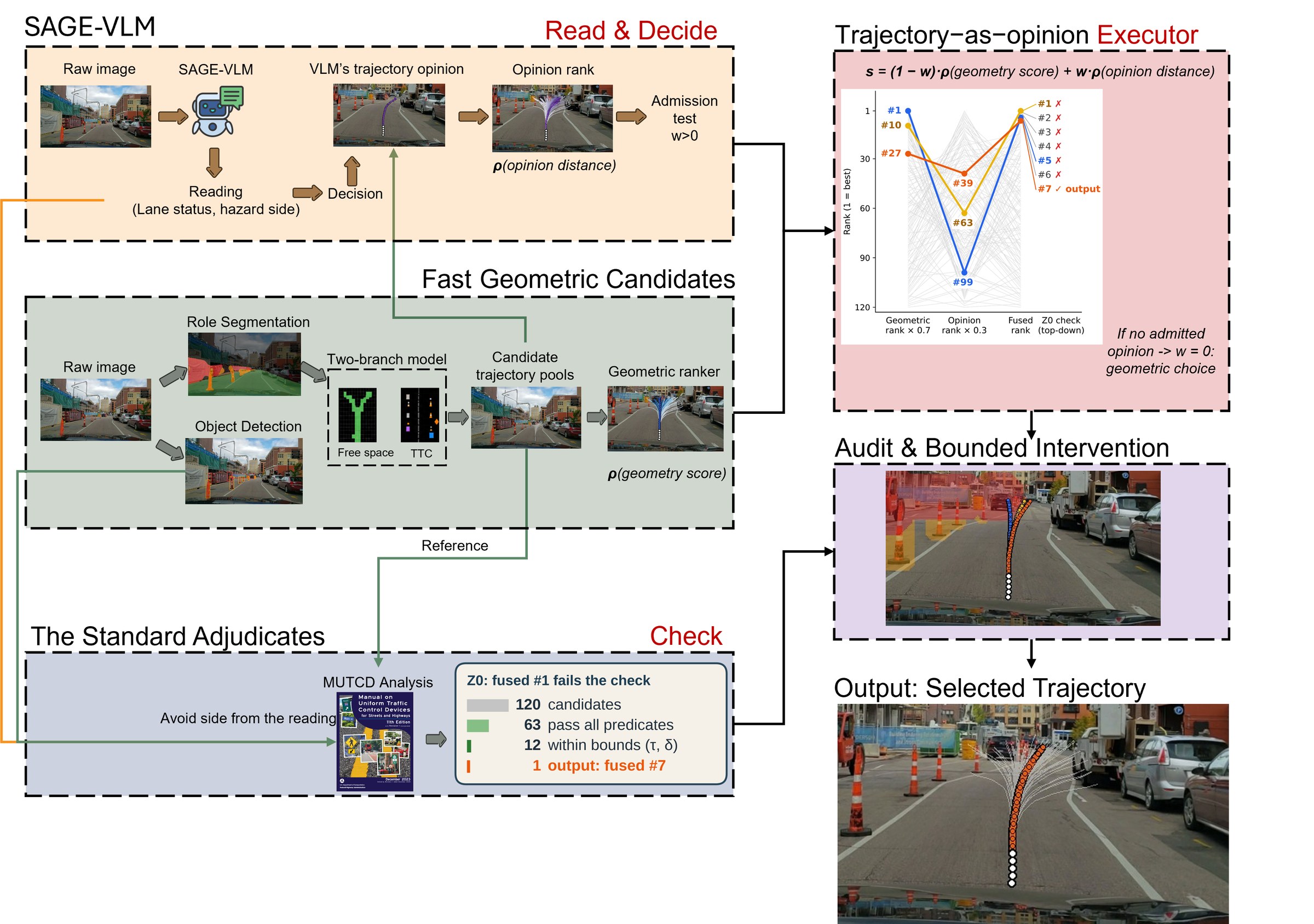
SAGE framework: SAGE-VLM reads and decides in the upper band, RD-YNet proposes geometric candidates in the middle band, MUTCD predicates and the bounded intervention check the choice in the lower band, and the trajectory-as-opinion executor fuses geometric and opinion ranks on the right.
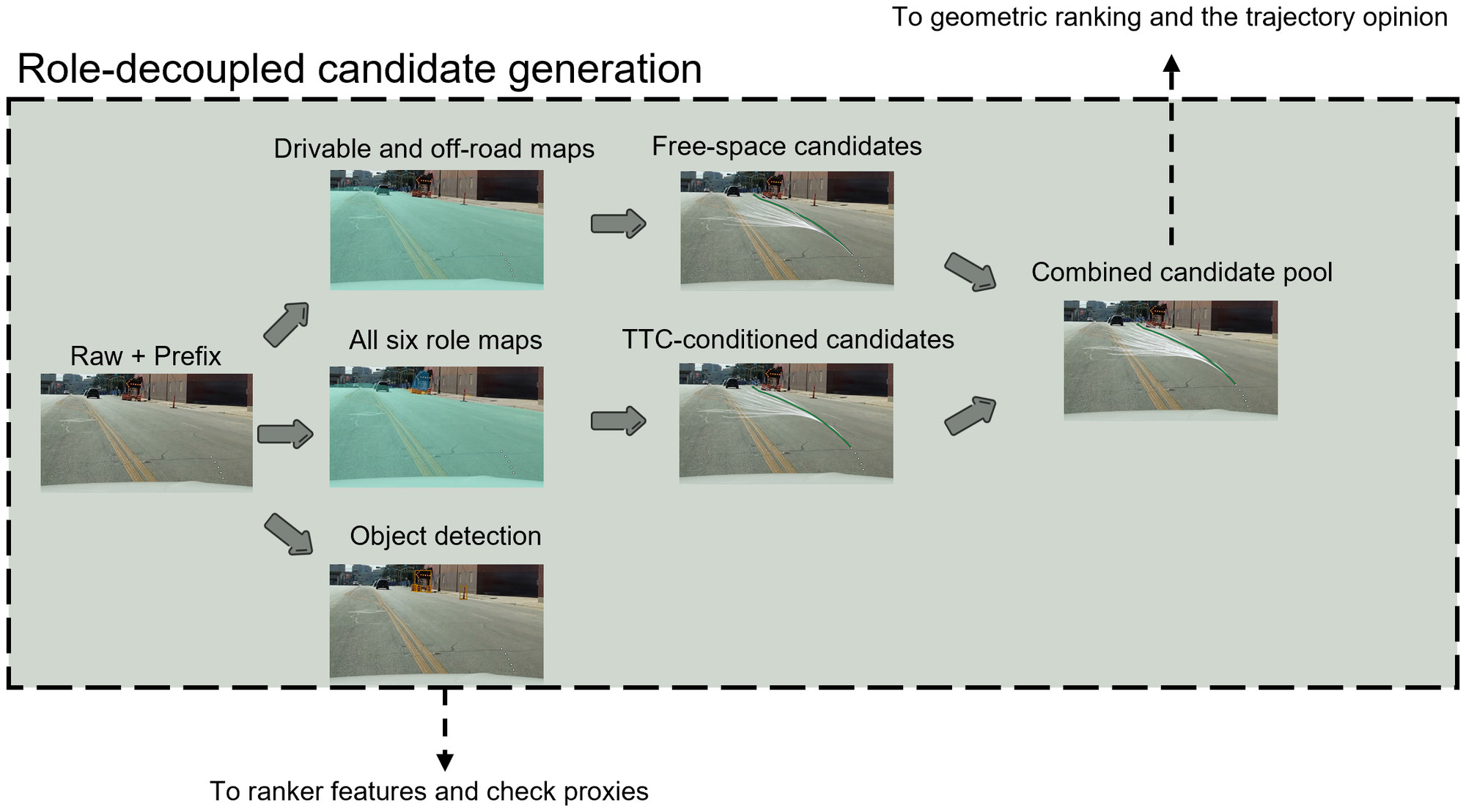
Overview of SAGE. Middle band: role segmentation conditions the free-space and TTC-conditioned branches of RD-YNet, which propose 60 + 60 intact candidates, and a geometric ranker scores them. Upper band: SAGE-VLM states the lane status and hazard side, a passage decision, a goal, and a 15-point trajectory; its distance to each candidate yields an opinion rank. Right: the executor fuses the geometric and opinion ranks (SAGE w/o VLM blue, SAGE w/o Z0 yellow, SAGE output orange). Lower band: MUTCD predicates drive the audit and the bounded intervention Z0. Select a figure to enlarge it.
Read

State the work zone

SAGE-VLM first states the lane status and the hazard side, the side from which traffic is redirected.

reading + decision 0.73 s
Decide

Commit to a passage

It then gives a passage decision, a goal, and a 15-point trajectory, which SAGE uses only as an opinion.

goal 0.92 s · path 3.04 s
Execute

Fuse two rankings

Each of the 120 RD-YNet candidates gets a geometric rank and an opinion rank from its distance to the SAGE-VLM path.

60 + 60 candidates
Check

Apply MUTCD predicates

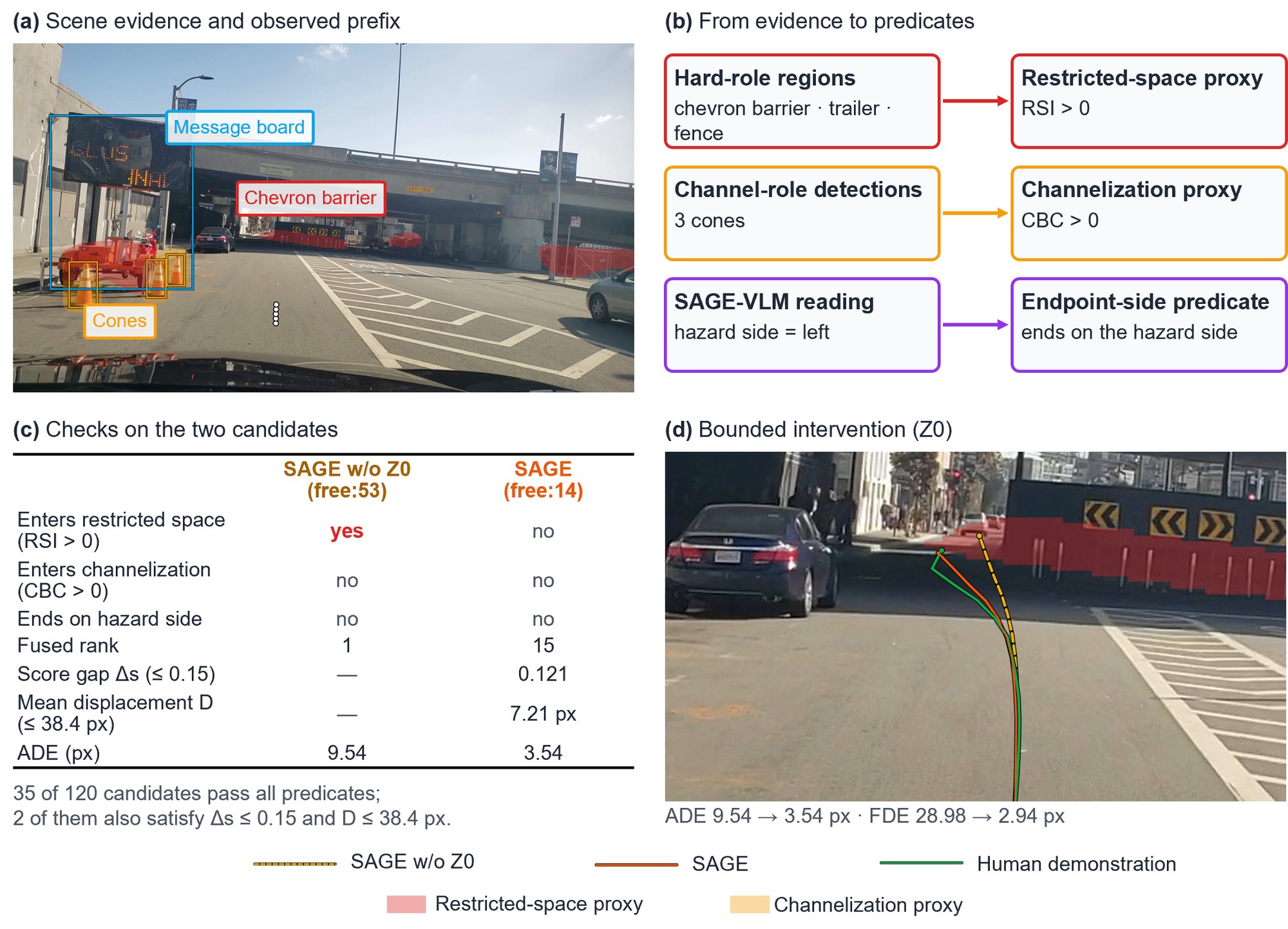
Z0 may replace a failing choice with the highest-ranked passing candidate within Δs ≤ 0.15 and D ≤ 38.4 px.

no trainable parameters

s(j) = 0.7 · ρ(geometric score) + 0.3 · ρ(distance to the SAGE-VLM path)  →  output: one of the 120 intact candidates

Inside the pipeline

Candidate generation with RD-YNet on a San Antonio frame: role maps and detections, free-space and TTC-conditioned branches, and the combined pool of 120 candidates.
Candidate generation with RD-YNet on a San Antonio validation frame. The free-space branch receives the drivable and off-road maps, and the TTC-conditioned branch receives all six role maps. The closest free-space candidate lies 11.08 px from the human demonstration and the closest TTC-conditioned candidate 3.31 px; the 10 candidates within 10 px all come from the TTC-conditioned branch.

The provisions behind the checks

MUTCD (11th ed.)Requirement (paraphrased)Predicate on every candidate
§6B.06 ¶02The work space is the portion of the highway closed to road users.RSI > 0: the path enters the restricted-space proxy.
§6B.05 ¶02Road users whose normal path must be redirected shall be directed to a new path with channelizing devices.CBC > 0: the path enters the channelization proxy.
§6L.06 ¶17, ¶19An arrow board in arrow or chevron mode is used only for lane closures; with the channelizing line it marks the closed side.The path ends on the hazard side stated in SAGE-VLM's reading.

The predicates are image-space proxies of the provisions; determining regulatory compliance requires a separate engineering assessment.

Watch SAGE decide

Four ROADWork validation frames, step by step. Every path, rank, reading, and check in the videos is a stored output of the evaluated system.

The bird's-eye view

Each path mapped onto the road with the paper's device-anchored metric frame: MUTCD drums (36 in, 0.91 m) calibrate the camera height and horizon of each recording with enough drums, the others use the median calibration, and a flat-ground pinhole model gives metres ahead and to the side.

Measures follow the paper's definitions. Lateral error compares each path with the demonstration at the same image row (the same distance ahead) within rows at least 80 px below the horizon. Lane tolerance holds when the maximum lateral error stays within 1.83 m, half of a 12-ft lane. Clearance is the gap between the 1.07-m half-width footprint of the AASHTO passenger car and a detected object at its ground-contact row; a value below −0.30 m counts as a strike.

Results

2,306 ROADWork validation episodes from 187 recordings.

−8.3%ADE of SAGE against its geometric ranker, with 12.0% lower FDE, mostly in the far field
−37%paths with a hard violation (strike, work-space intrusion, or channelization crossing): 2.73% → 1.73%
4 / 4generator–selector combinations improved by the SAGE-VLM opinion, by 0.73–1.33 px
3.45 sfor SAGE-VLM's reading, decision, goal, and path, against 4.26 s for OneVL's trajectory on the same network
MethodADEpx ↓FDEpx ↓Lat. err.m ↓Lane miss% ↓Collision% ↓Hard viol.% ↓Score0–100 ↑Hazard side% ↓
Path models without language
Constant-velocity extrapolation21.5159.760.1746.682.066.5793.1–
Generic planner (one Y-Net branch)14.0635.080.1333.781.012.4095.91.16
ROADWork released Y-Net38.5875.990.2206.381.493.4586.94.17
VLM / VLA paths executed directly
Qwen2.5-VL-7B (zero-shot)25.8164.900.1966.992.016.6691.80.54
Senna (ROADWork LoRA)18.7354.240.1455.541.886.3693.31.24
Impromptu-VLA (ROADWork LoRA)17.2652.240.1264.511.445.1894.21.85
LightEMMA† (ROADWork LoRA)14.4247.550.1044.211.345.0894.52.78
OpenEMMA† (ROADWork LoRA)14.4547.500.1074.351.155.0594.62.24
OneVL (authors' ROADWork checkpoint)12.7429.020.1143.260.772.8396.52.63
SAGE-VLM12.1535.860.1103.230.923.3395.32.25
SAGE and its ablations
SAGE w/o VLM12.8534.630.1093.260.862.7395.91.47
SAGE w/o Z011.7430.340.1083.080.772.1196.60.85
SAGE (ours)11.7930.490.1083.080.771.7396.90.69

ADE and FDE in source-image pixels (1920 × 1080); lateral error and lane misses in the device-anchored metric frame. Collision, hard violations, and the safety score use the 2,086 human-filtered episodes; hazard side is the share of paths ending on the side named in the human scene description, among the 1,295 episodes whose demonstration ends elsewhere. †The prompt contains ROADWork's human scene description. Bold marks the best value in each column.

Hard violations

Share of paths that strike an object, intrude into the work space, or enter the channelization (%, human-filtered)

The opinion improves every geometric layer

ADE alone (gray) → with the SAGE-VLM opinion (orange), px; every 95% recording-clustered interval excludes zero

When each piece arrives

Median per frame, batch size 1, one RTX 6000 Ada. The geometric layer returns a complete candidate pool before SAGE-VLM states its reading, and the reading arrives before the trajectory.
Qualitative results

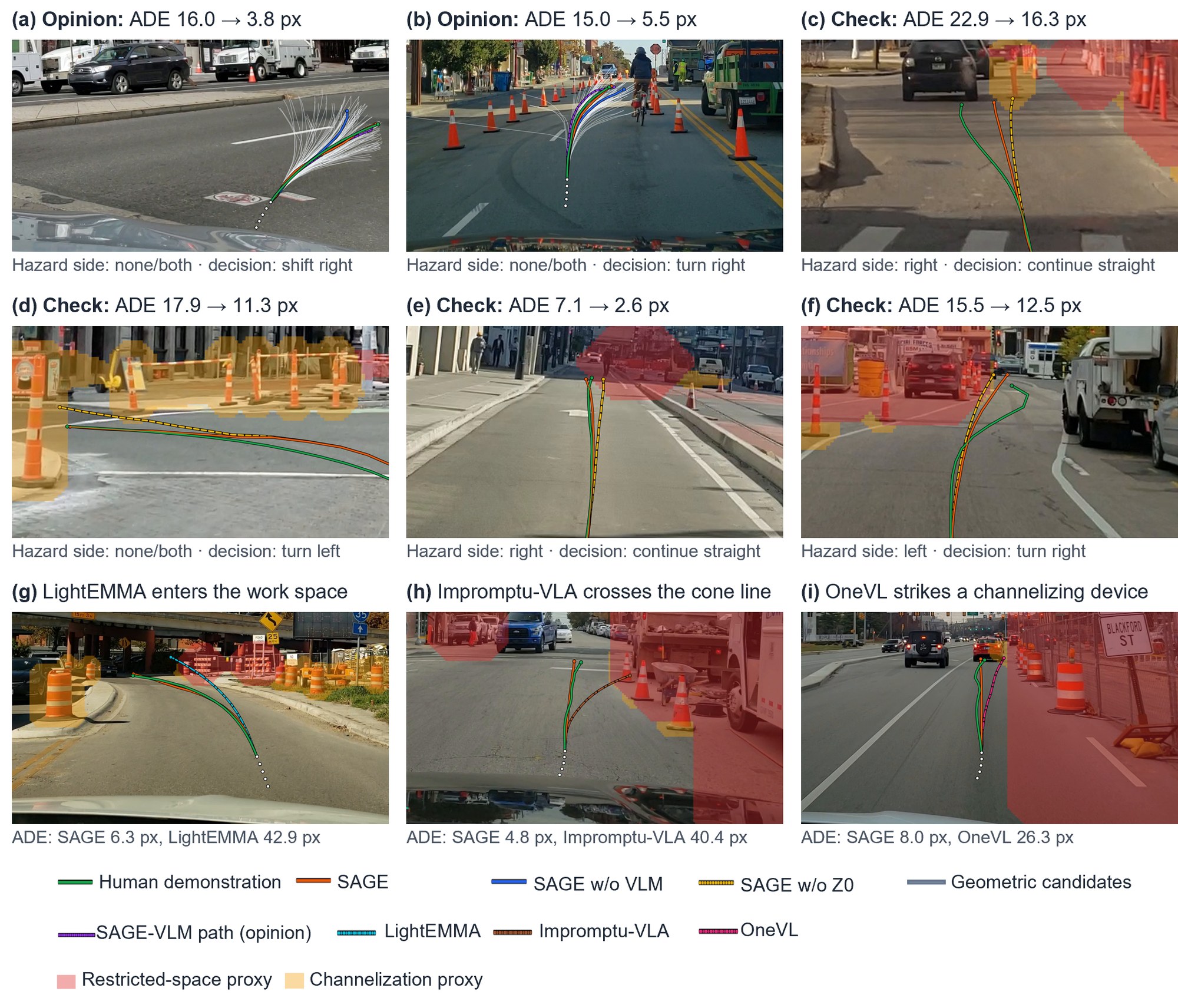
Nine validation cases with choices of SAGE w/o VLM, SAGE-VLM paths, choices of SAGE w/o Z0, SAGE outputs, VLM paths executed directly, and human demonstrations.
Nine validation cases. (a, b) The SAGE-VLM opinion selects a candidate close to the human demonstration that the geometric ranker placed lower. (c–f) Z0 replaces a choice of SAGE w/o Z0 that enters the restricted-space or channelization proxy with a nearby candidate that does not. (g–i) LightEMMA, Impromptu-VLA, and OneVL, executed directly, violate a hard constraint, while SAGE does not.

BibTeX

@misc{liu2026sage,
  title  = {{SAGE}: A hybrid vision--language and geometry framework for
            work-zone pathway prediction under temporary traffic control},
  author = {Liu, Jiaxi and Tang, Weizhe and Cao, Bofeng and Chen, Sikai and Li, Xiaopeng and Parker, Steven T. and Ran, Bin},
  year   = {2026}
}